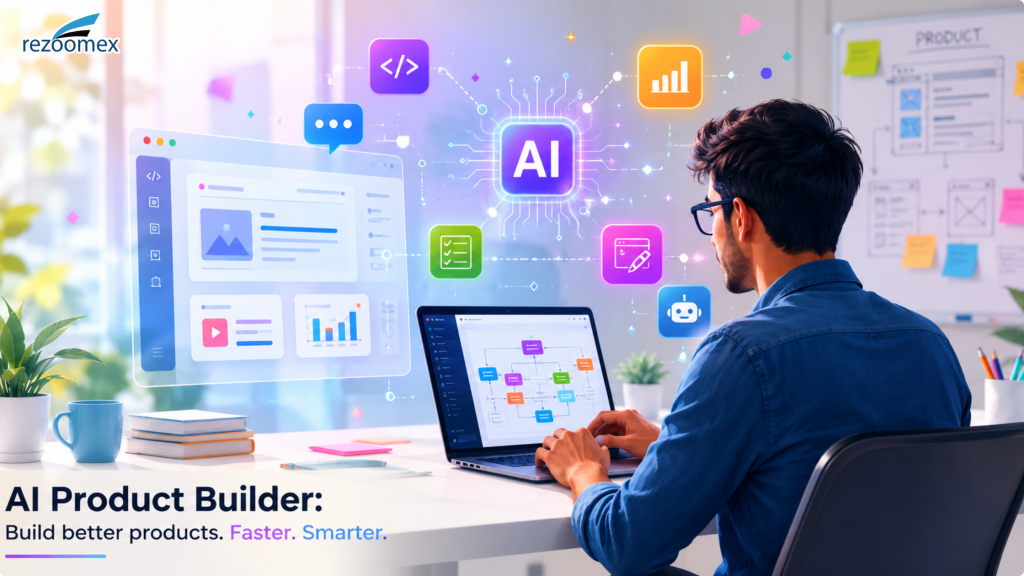
As AI lowers the cost of turning ideas into working software, the real sources of competitive advantage may be shifting elsewhere.
For most of the software era, building a product was expensive.
A company needed developers, designers, product managers, infrastructure, testing, months of development, and significant capital before an idea could become a working product.
That constraint shaped how companies operated.
Ideas had to compete for engineering capacity. Features were prioritized carefully. Startups raised money partly to assemble teams capable of turning their ideas into software.
But something important is changing.
AI-assisted development tools can now generate code, tests, documentation, interfaces, prototypes, and increasingly complete multi-step development tasks. In Stack Overflow’s 2025 Developer Survey, 84% of respondents said they were already using or planning to use AI tools in their development process, while 51% of professional developers said they used them daily. Stack Overflow Survey
DORA’s 2025 research, based on nearly 5,000 technology professionals, found similarly widespread adoption. By early 2026, DORA reported that 90% of technology professionals were using AI at work and more than 80% believed it had increased their productivity. Google Research
The implication goes beyond developers writing code faster.
We may be entering a world where software itself becomes significantly cheaper to produce.
And when something becomes cheaper, the things around it become more important.
The cost of turning an idea into software is falling
Consider what building even a relatively simple digital product traditionally involved.
A team might have to research the problem, create requirements, design interfaces, write application code, develop APIs, create tests, configure infrastructure, produce documentation, fix bugs, and deploy the application.
AI doesn’t eliminate all of those activities.
But it can increasingly participate in many of them.
GitHub’s research has previously found developers completing a controlled coding task up to 55% faster with Copilot. A later randomized study involving 202 experienced Python developers also found that code produced with Copilot was more likely to pass all tests and was over 10% more likely to pass code review. The GitHub Blog
AI agents are extending the idea further.
Instead of merely suggesting the next line of code, an agent can be given a task, inspect a repository, modify multiple files, run tests, identify failures and iterate on the solution.
The progression looks something like this:
Manual development → AI-assisted development → AI-orchestrated development
The economics are potentially significant.
If the same team can explore more ideas, produce prototypes faster and automate portions of implementation and testing, the effective cost of experimenting with software falls.
But that doesn’t mean every software organization suddenly becomes dramatically more productive.
There is an important catch.
Faster coding does not automatically mean cheaper software
The evidence around AI productivity is more complicated than the headlines sometimes suggest.
A 2025 randomized controlled trial by METR studied experienced open-source developers completing 246 real tasks in mature repositories they knew well. Developers expected AI to make them faster.
Instead, with the early-2025 tools tested, they took 19% longer when AI was available. Metr
METR later cautioned that those findings had become dated as AI tools improved. Its subsequent experiment suggested that newer tools were probably providing greater speedups, but selection effects made the magnitude difficult to estimate reliably. Metr
This distinction matters.
Generating code cheaply is not the same as producing reliable software cheaply.
AI-generated code still needs context, architecture, testing, security, integration, review and maintenance.
Stack Overflow’s survey illustrates the tension clearly: 46% of developers distrusted the accuracy of AI output, compared with 33% who trusted it. And 66% cited AI solutions that are “almost right” as a major frustration. Stack Overflow Survey
DORA describes AI as an amplifier: it can magnify the strengths of well-functioning organizations, but also amplify weaknesses in poorly functioning systems. Google Cloud
So the more interesting question isn’t:
Will AI make software free?
It is:
What becomes valuable when producing software becomes substantially easier?
Several answers are beginning to emerge.
1. Knowing what to build becomes more valuable
When development is expensive, the cost itself limits experimentation.
If building a product takes six months, organizations naturally hesitate before starting.
But imagine being able to produce a credible prototype in days.
Suddenly, the bottleneck shifts.
The difficult question is no longer simply:
Can we build this?
It becomes:
Should we build this?
That makes problem discovery, customer understanding and product judgment increasingly important.
AI can generate ten product ideas.
It can generate ten interfaces.
It may eventually be able to implement all ten.
But someone still has to determine which problem is worth solving.
Ironically, cheaper software could therefore make bad product decisions more expensive—not because each individual product costs more, but because organizations can build the wrong things at unprecedented speed.
The faster we can build, the more important it becomes to choose carefully what deserves to be built.
2. Domain knowledge becomes a stronger advantage
Suppose two companies have access to similar AI models, cloud platforms, frameworks and coding agents.
What differentiates them?
Increasingly, it may be what those tools don’t already know.
A company operating deeply within healthcare understands workflows, regulations, reimbursement processes and the everyday frustrations of clinicians.
A logistics company understands routing constraints, warehouse operations and exceptions that rarely appear in a product specification.
A financial organization understands risk processes and regulatory obligations.
That knowledge—especially the tacit knowledge accumulated through experience—is difficult to reproduce simply by prompting a model.
When the technology for building becomes widely accessible, knowing where and how to apply it becomes more valuable.
3. Distribution may matter more than development
Imagine that five startups can now build comparable products in months rather than years.
What separates them?
Potentially:
Who has customers?
Who has trust?
Who has a recognizable brand?
Who understands the market?
Who has partnerships?
Who can reach buyers efficiently?
Software history has never been purely about technical superiority. Distribution has always mattered.
But cheaper development could strengthen its importance.
If competitors can reproduce features more quickly, features themselves may provide a shorter-lived advantage.
Customer relationships, ecosystems, proprietary data, operational integration and brand trust can be much harder to copy.
4. Experimentation becomes cheaper—and therefore more important
There is another side to lower development costs.
Failure becomes cheaper.
Historically, testing a software idea could require substantial upfront investment. If AI makes prototyping dramatically faster, companies can run more experiments before committing significant resources.
Instead of:
Idea → Business case → Large project → Build → Launch → Hope
teams can move toward:
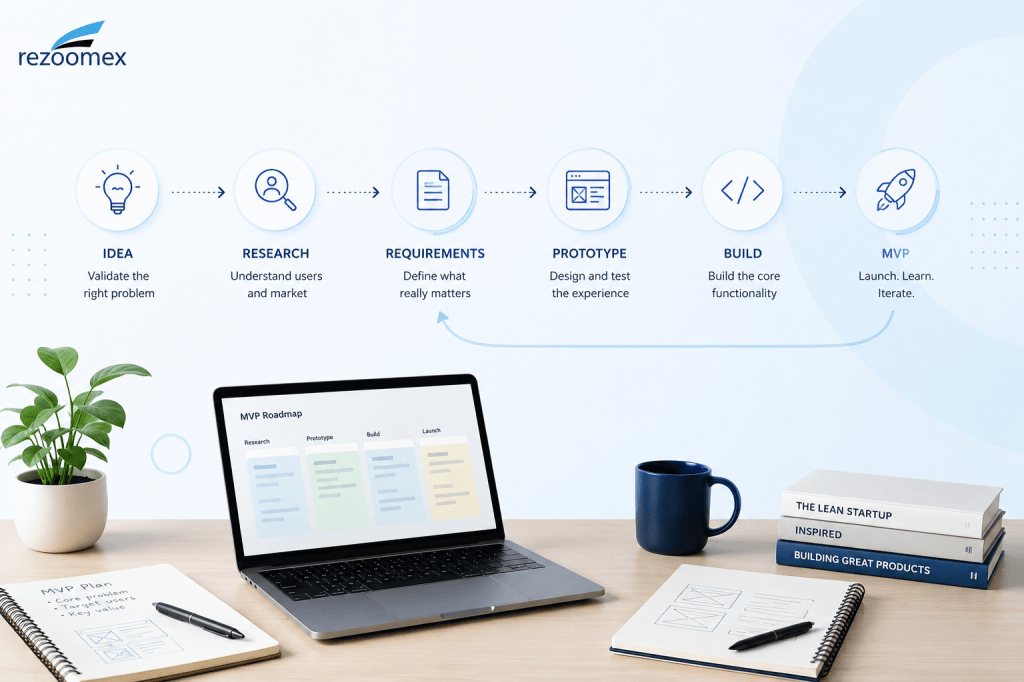
Problem → Hypothesis → Prototype → Test → Learn → Improve
That could be one of AI’s most important effects on product development.
Not simply producing the same software faster, but allowing organizations to learn faster.
The organization capable of running ten meaningful experiments may discover something the organization running one large project never sees.
5. The bottleneck moves downstream—from building to outcomes
There is a deeper consequence.
Suppose AI eventually makes it possible to build an application in a fraction of the time required today.
You deploy it.
Then what?
Did customers use it?
Did support requests decline?
Did conversion improve?
Did processing time fall?
Did revenue increase?
Did the operational problem actually disappear?
Software being easier to build doesn’t make those questions easier to answer.
In fact, it makes them more important.
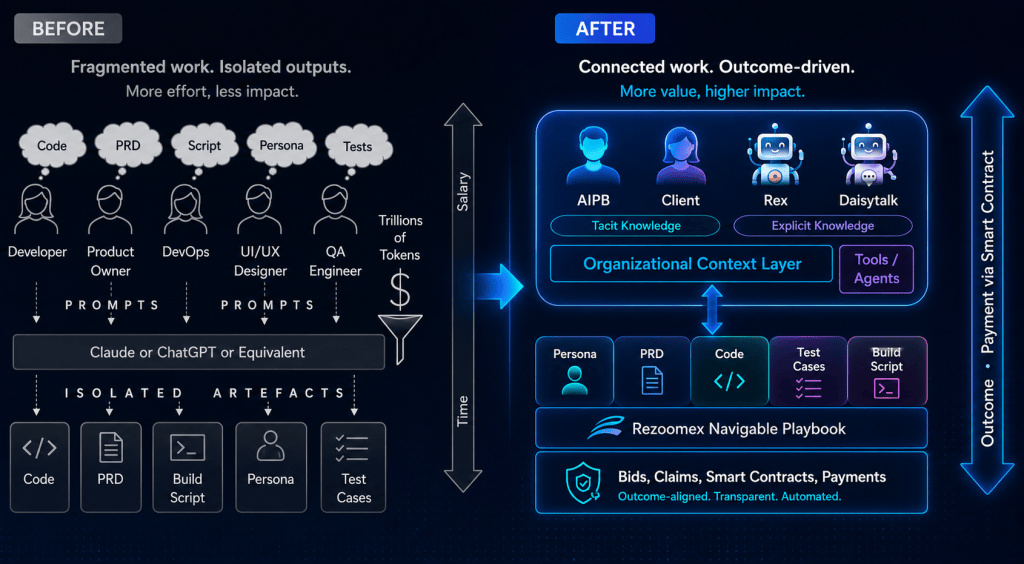
This suggests a shift from thinking primarily about the development value stream:
Idea → Requirements → Build → Test → Deploy
toward the broader operational value stream:
Problem → Desired Outcome → Intervention → Build → Deploy → Measure → Improve → Outcome
Deployment stops being the finish line.
It becomes one point in a much longer journey.
More software may also mean more complexity
There is another possibility worth considering.
If software becomes cheaper to create, organizations may simply create much more software.
More internal applications.
More automations.
More agents.
More APIs.
More experiments.
More generated code.
That creates a different problem: complexity.
Someone still has to understand how these systems interact, maintain them, secure them and decide when they should be retired.
This is why the productivity question cannot be measured only by lines of code or features shipped.
Stack Overflow found that among developers already using AI agents, roughly 70% said agents reduced time spent on specific development tasks and 69% reported increased productivity. Yet only 17% said agents improved collaboration within their teams. Stack Overflow Survey
Local productivity and organizational productivity aren’t necessarily the same thing.
Generating more software is useful only when that software creates sufficient value to justify the complexity it introduces.
The scarce resource is moving
For decades, software development capability itself was scarce.
It still requires considerable expertise, and complex production systems remain difficult to build well. But AI is steadily lowering the barrier between having an idea and having working software.
As that barrier falls, competitive advantage may migrate elsewhere.
From coding capacity toward problem selection.
From feature production toward customer understanding.
From technical access toward domain knowledge.
From shipping toward distribution.
From output toward measurable outcomes.
And from asking:
“Can we build this?”
toward asking:
“Is this worth building—and what will actually change if we do?”
That may ultimately be the more important consequence of cheaper software.
Because when almost everyone can build, the advantage won’t simply come from building more.
It will come from knowing what matters enough to build in the first place—and turning what you build into an outcome that matters.
Building for What Matters
At Rezoomex, we’re exploring what this shift means for the way products are imagined, built, and delivered—from using AI across the product lifecycle to connecting software development more closely with measurable outcomes.
Explore Rezoomex to discover more about our thinking on AI Product Builders, AI agents, product development, and building technology around outcomes that matter.
Akshay Moon is a digital marketing professional and technology writer at Rezoomex, where he explores the intersection of AI, blockchain, remote work, product development, and the evolving future of work. Through his writing, he shares insights on emerging technologies, global talent trends, outcome-driven work models, and how organizations can adapt to a rapidly changing digital economy.