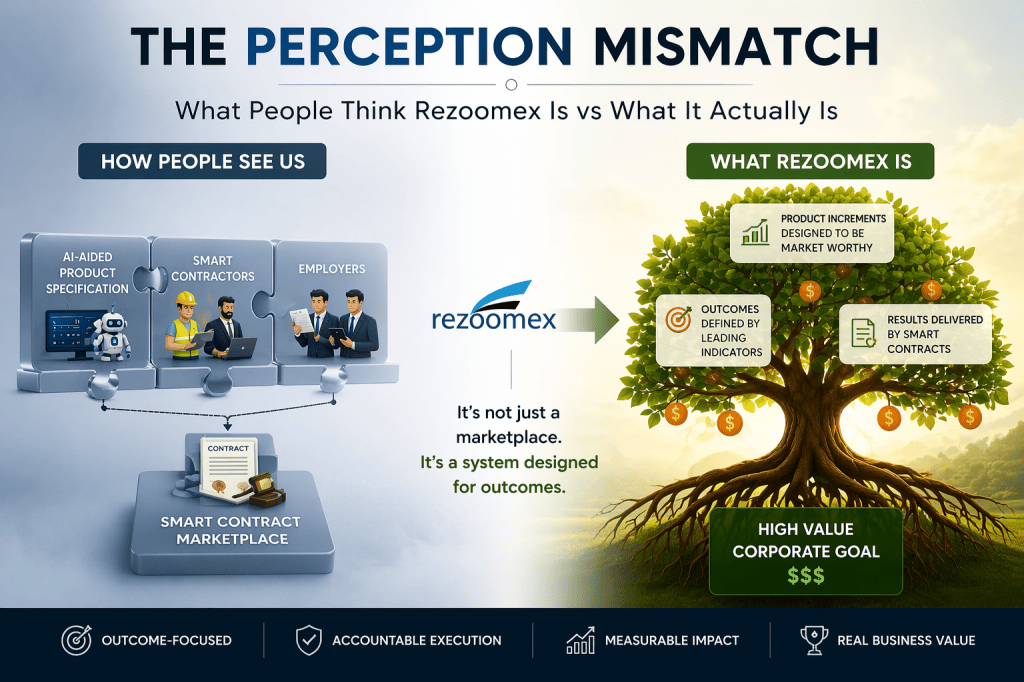
The Perception Mismatch: What People Think Rezoomex Is vs What It Actually Is 

There’s a common pattern we’ve started to notice. When people first hear about Rezoomex, they try to fit it into something familiar. 

A platform. A marketplace. A combination of AI tools, smart contractors, and employers. And on the surface, that interpretation makes sense. 

If you look at it from the outside, you might see AI aiding product specifications, smart contractors executing work, and employers driving demand, coming together as what appears to be a smart contract marketplace. 

But that’s only part of the picture.

Continue reading “The Perception Mismatch: What People Think Rezoomex Is vs What It Actually Is “
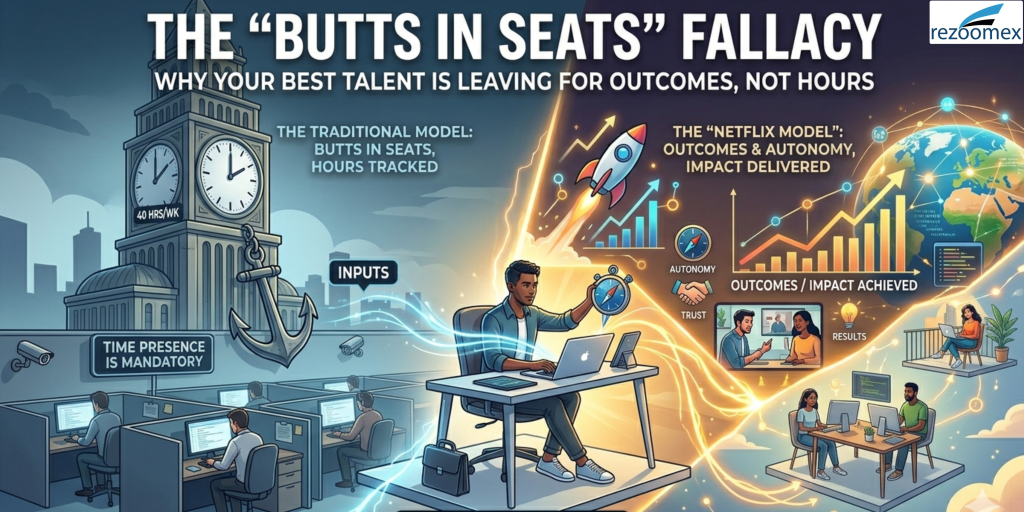

The “Butts in Seats” Fallacy: Why Your Best Talent is Leaving for Outcomes, Not Hours

By 2026, the technology landscape has evolved at a breakneck pace. We have autonomous AI agents managing cloud infrastructure and neural networks predicting consumer behavior with terrifying accuracy. Yet, walk into many organizations, and you’ll find a management style that dates back to the steam engine: the “input-based” model.

The belief that a developer’s value is directly proportional to the number of hours their Slack dot remains green—or worse, the hours they spend sitting in a physical office—is more than just an outdated relic. It is a competitive liability.

Continue reading “The “Butts in Seats” Fallacy: Why Your Best Talent is Leaving for Outcomes, Not Hours”

How Distributed Teams Are Outperforming Traditional Teams (With Data)

For years, the idea of a “strong team” was tied to a physical office—people working side by side, collaborating in real time.

But that model is changing.

Today, distributed teams—spread across cities, countries, and time zones—are not just an alternative. In many cases, they are outperforming traditional, office-based teams, backed by data.

Continue reading “How Distributed Teams Are Outperforming Traditional Teams (With Data)”