
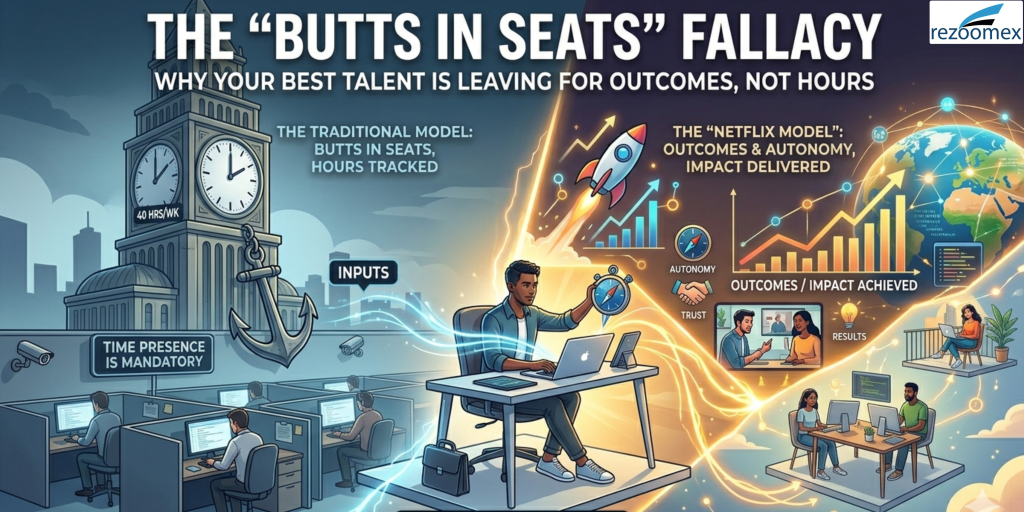
By 2026, the technology landscape has evolved at a breakneck pace. We have autonomous AI agents managing cloud infrastructure and neural networks predicting consumer behavior with terrifying accuracy. Yet, walk into many organizations, and you’ll find a management style that dates back to the steam engine: the “input-based” model.
The belief that a developer’s value is directly proportional to the number of hours their Slack dot remains green—or worse, the hours they spend sitting in a physical office—is more than just an outdated relic. It is a competitive liability.
The Industrial Relic vs. The Intellectual Reality:
The 40-hour workweek was designed for the assembly line, where output was a linear function of time. If a worker stayed at the conveyor belt for eight hours, they produced X units. If they stayed for ten, they produced X + Y.
In software engineering, this logic fails spectacularly. Coding is an act of creative problem-solving, not manual labor. A senior developer might spend four hours “staring at a wall” and then write ten lines of code that save the company $100,000 in server costs. Conversely, a junior developer might spend 60 hours “working hard” while inadvertently creating technical debt that will take months to pay off.
When we measure “hours logged,” we aren’t measuring value; we are measuring endurance. And high-performers aren’t interested in an endurance contest.
The “Netflix Model” of Radical Autonomy:
To attract the top 1% of talent, organizations must shift toward what is often called the “Netflix Model” of autonomy. This philosophy is built on a simple, albeit terrifying, premise: High Talent Density.
When you hire exclusively high-performing individuals, you don’t need to manage their time. You only need to manage the context. This model trades surveillance for accountability. Employees are given total freedom—flexible hours, unlimited autonomy on how they work, and a focus on asynchronous communication—in exchange for a relentless commitment to excellence.
If a developer can finish a week’s worth of sprints in two days because they found a more efficient way to architect the solution, the “Netflix” response isn’t to give them three more days of busy work. It’s to celebrate the efficiency.
Moving from Guard to Guide: The Manager’s New KPI:
The biggest hurdle to this transition isn’t the technology; it’s the ego of management. Many leaders feel they aren’t “working” if they aren’t watching. To survive in a distributed, outcome-based world, managers must shift from being guards (checking timestamps) to guides (providing context).
1. Context, Not Control: Instead of approving every line of code or micromanaging a daily schedule, a manager’s job is to ensure the team understands the why behind a project.
2. The “Done” State: Success must be defined by measurable impact. “I worked on the API” is a task. “The API now handles 20% more concurrent requests with zero latency increase” is an outcome.
Three Steps to Transitioning Without the Chaos:
Moving to an outcome-based model doesn’t mean “zero rules.” It means “smarter rules.”
1. Define Results, Not Activities: Stop tracking “sprint points” as a measure of effort and start tracking “Business Value Delivered.” If the feature doesn’t solve the user’s problem, it doesn’t matter how many points it was worth.
2. Asynchronous by Default: Meetings are the “butts in seats” of the digital world. Move status updates to documentation or recorded clips. Use live meetings only for complex brainstorming or team bonding.
3. Hire for Trust, Not Resumes: The reason managers micromanage is often because they don’t trust their team. This is why vetting is critical. At Rezoomex, we focus on verified skills and “outcome-readiness.” When you know your team is composed of experts, the urge to check their “online” status disappears.
The Competitive Edge:
The most talented engineers in 2026 are no longer looking for a “9-to-5.” They are looking for a mission where they are treated like professional athletes—judged by the score at the end of the game, not how long they spent in the locker room.
Organizations that continue to prioritize presence over performance will find themselves left with the “B-players” who are happy to trade time for a paycheck. Meanwhile, the high-performers will be busy building the future, likely from a location (and at a time) of their own choosing.
The question for leadership is no longer “How do I know they are working?” but rather, “Is what they are producing moving the needle?”
If the answer is yes, does the clock really matter?
With an overall experience of more that 7 years, Akshay Moon is someone who specializes in content marketing and has always managed to create quality content. He is currently working with Rezoomex as a Digital Marketing Executive.
Passionate about sports, particularly obsessed with cricket, anything related to the game is enough to attract Akshay’s attention.

