
Why the next stage of AI at work may be about moving from task productivity to outcome ownership
AI has already changed what a productive workday looks like.
A developer can generate code in minutes. A product professional can draft a PRD with a few prompts. A QA engineer can create test cases faster. A designer can explore multiple concepts before the first meeting of the day.
Work that once consumed hours can increasingly be completed in a fraction of the time. For professionals, that sounds like an obvious win.
But it creates a more uncomfortable question:
If AI helps you complete eight hours of work in two, what happens to the other six? More importantly: Has your value to the organization increased simply because the task took less time?
That distinction may become one of the defining career questions of the AI era.
The Growing Anxiety Behind AI Productivity
But behind the excitement around AI productivity is a growing concern for professionals: if AI allows the same amount of work to be completed with fewer people and fewer hours, what happens to existing jobs? That anxiety is becoming harder to ignore. According to Challenger, Gray & Christmas, AI was cited in 112,713 announced U.S. job cuts through July 2026, accounting for roughly 24% of all announced cuts during the period. The World Economic Forum has also reported that 41% of surveyed employers expect to reduce their workforce where AI can automate certain tasks, even as many organizations simultaneously plan to invest in reskilling their people.
For professionals, this creates a critical career question. If AI can increasingly perform parts of my current role, how do I make myself more valuable—not simply more productive? The answer may not be trying to protect every existing task from automation. It may be about expanding the value you can create: understanding larger problems, working across traditional functional boundaries, orchestrating AI tools and agents, and taking greater ownership of the outcomes an organization actually cares about. This is where the shift from being an AI user to becoming an AI Product Builder begins.
The AI Productivity Paradox
Most conversations about AI at work focus on productivity.
Can developers code faster?
Can marketers produce more content?
Can product managers write requirements faster?
Can designers create prototypes faster?
Can QA teams generate more test cases?
The answer increasingly appears to be yes.
But there is a difference between individual productivity and organizational value.
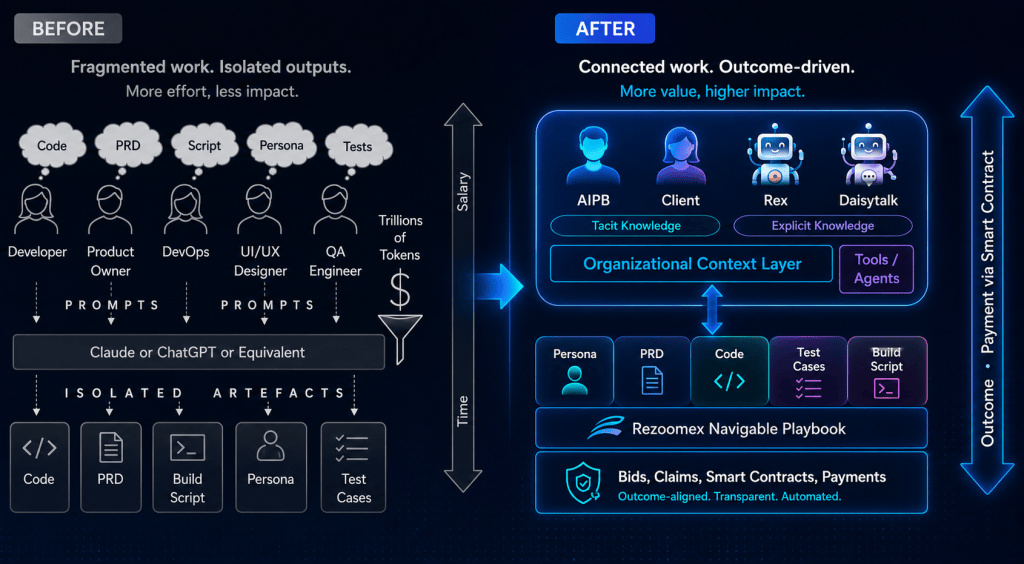
Imagine five professionals working on the same product:
- A developer uses AI to generate code.
- A product manager uses AI to create a PRD.
- A designer uses AI to create interfaces.
- A QA engineer generates test cases.
- A DevOps engineer generates deployment scripts.
Every person becomes significantly faster.
At first glance, the organization has become AI-powered.
But has it?
The organization may simply have become better at producing individual artifacts faster.
Code.
PRDs.
Designs.
Test cases.
Build scripts.
These outputs can certainly be useful. But none of them, by themselves, are the outcome a business ultimately wants.
Organizations Don’t Buy Tasks. They Need Outcomes.
Businesses don’t exist to produce more PRDs.
They don’t succeed because developers generated more lines of code.
They don’t win markets because teams created more test cases.
Organizations care about outcomes such as:
Faster time to market. Better customer experiences. Higher revenue. Lower costs. Greater market share. Better products. Competitive advantage.
This creates an important shift in how we should think about AI productivity.
The question is no longer simply:
“How much faster can AI help me perform my current job?”
A much more important question is:
“How can I use AI to contribute to outcomes that matter to my organization?”
That is where professional value begins to change.
Faster Doesn’t Automatically Mean More Valuable
Suppose a task previously took eight hours.
AI reduces it to two.
From an efficiency perspective, that’s remarkable.
But from an organizational perspective, several questions remain.
Did the product reach customers sooner?
Did customer satisfaction improve?
Did revenue increase?
Did the company learn something important about its market?
Did the organization gain an advantage over competitors?
Did the team solve the right problem in the first place?
If the answer to these questions is unclear, AI may have improved the speed of work without necessarily improving the impact of work.
And that creates a challenge for professionals.
If the primary value of a role is defined by performing a particular set of tasks, and AI dramatically reduces the effort required to perform those tasks, organizations will inevitably reconsider how those roles should operate.
The answer doesn’t have to be competing with AI on task execution.
It could be moving higher up the value chain.
From AI User to AI Product Builder
This is where the idea of the AI Product Builder (AIPB) becomes interesting.
An AI Product Builder isn’t simply someone who knows how to prompt an AI model.
And it isn’t necessarily another name for a developer.
The role represents a broader shift:
From executing a function to taking greater ownership of an outcome.
Instead of asking:
“How can AI help me write this code?”
an AIPB begins with:
“What problem are we trying to solve?”
Instead of stopping after generating a PRD:
“What needs to happen for this idea to become a working product?”
Instead of optimizing one isolated stage:
“How do all the stages connect to the outcome the organization needs?”
AI then becomes leverage throughout that journey rather than simply a faster tool for completing one task.
Think Across the Product Lifecycle
Traditional organizations often divide product development into specialized functions.
Product defines requirements.
Design creates experiences.
Engineering builds.
QA tests.
DevOps deploys.
Each specialization remains valuable.
But AI increasingly allows professionals to understand, participate in and orchestrate activities beyond the traditional boundaries of their role.
An AIPB could therefore think across a connected journey:
Problem → User → Requirements → Design → Build → Test → Deploy → Feedback → Outcome
AI tools and agents can assist at different stages.
But the human role changes from merely generating an artifact to understanding why that artifact exists and how it contributes to the larger objective.
That requires more than prompting ability.
It requires product thinking.
The Most Valuable AI Skill May Be Context
AI can generate remarkably sophisticated outputs.
But an organization possesses something a general-purpose AI model doesn’t automatically have: context.
Why does this company exist?
Who are its customers?
What has already been tried?
What constraints does the team operate under?
What does success mean?
What trade-offs are acceptable?
What knowledge exists inside the organization?
What outcome is the business trying to achieve?
Without context, AI can generate impressive artifacts that don’t necessarily move the organization forward.
That’s why the future of AI-enabled work may not simply belong to whoever writes the best prompt.
It may belong to professionals who can combine:
AI capability + domain knowledge + organizational context + product thinking + outcome ownership.
That combination is much harder to commoditize.
Your Existing Experience Becomes an Advantage
This also means becoming an AI Product Builder shouldn’t be viewed as something reserved only for software engineers.
Consider someone with years of experience in healthcare, finance, logistics, HR, manufacturing or retail.
They may not be the strongest programmer in the room.
But they may understand problems that a general-purpose AI model doesn’t.
They know the workflows.
They know the customer frustrations.
They know where organizations lose time.
They know which processes repeatedly fail.
They understand what people actually need.
Combine that tacit knowledge with AI capabilities and a structured approach to building products, and that professional may be able to create enormous value.
This is why the AIPB opportunity can potentially extend across both technical and non-technical backgrounds.
The question becomes less:
“Can you code everything yourself?”
and more:
“Can you understand a valuable problem and orchestrate the capabilities required to solve it?”
From Job Security to Value Security
AI has understandably created anxiety around jobs.
But perhaps job security is not the most useful framework for thinking about the future.
Roles change.
Technologies change.
Organizations change.
Job descriptions change.
A stronger goal may be value security.
Can you continually demonstrate that you understand problems worth solving?
Can you connect your work to business outcomes?
Can you use new technologies to increase your leverage?
Can you work across traditional functional boundaries?
Can you help an organization move from an idea to something customers actually value?
Professionals capable of doing that may become increasingly important—even as the individual tasks involved in building products become more automated.
AI Should Expand Your Responsibility, Not Just Your Output
There are two possible ways professionals can respond to AI.
The first is:
“AI allows me to perform my existing tasks faster.”
The second is:
“Because AI allows me to perform these tasks faster, what larger responsibility can I now take?”
That second question changes everything.
Perhaps a developer begins understanding customer problems.
Perhaps a product manager becomes capable of building prototypes.
Perhaps a designer starts validating product hypotheses.
Perhaps an analyst turns an operational problem into a working solution.
Perhaps a domain expert who previously depended entirely on a technical team can now participate directly in product creation.
AI doesn’t merely compress work.
It can potentially expand the scope of what one professional is capable of owning.
That is the opportunity behind the AI Product Builder.
The Rezoomex Approach: Giving AI Product Builders a Path to Follow
Knowing that you should become more outcome-oriented is one thing.
Knowing how to navigate from a problem to an outcome is another.
This is where Rezoomex’s approach to AI Product Building comes in.
The Rezoomex Product Playbook provides what we often describe as the “dotted lines to walk on.”
Instead of individuals independently generating disconnected artifacts with AI, the Playbook helps connect activities across the product lifecycle.
A persona isn’t simply generated because an AI tool can create one.
It informs product understanding.
A PRD isn’t an isolated document.
It connects product intent with what needs to be built.
Code isn’t simply generated faster.
It contributes to a defined product outcome.
Testing isn’t simply another AI-generated artifact.
It helps validate whether what was built actually works as intended.
The objective is to connect AI-powered execution with organizational context and measurable outcomes.
Rezoomex is exploring this further through its Product Playbook, AI agents and outcome-oriented approach to product development, including the use of Smart Contracts to connect work and payments to agreed outcomes.
The Career Question AI Is Creating
For years, professionals built careers by becoming increasingly skilled within a particular function.
That expertise isn’t suddenly irrelevant.
But AI may allow us to build another layer on top of it.
A developer can remain a developer—and develop AI Product Builder skills.
A designer can remain a designer—and develop AI Product Builder skills.
A product professional, QA engineer, analyst, DevOps professional or domain expert can do the same.
The goal isn’t necessarily to eliminate specialization.
It’s to help professionals understand how their expertise connects to the complete journey from problem to outcome.
Because as AI makes individual tasks easier, the ability to take responsibility for larger outcomes could become considerably more valuable.
AI Made You Faster. What Will You Do With That Speed?
The first chapter of workplace AI has largely been about productivity.
Write faster.
Code faster.
Research faster.
Design faster.
Analyze faster.
The next chapter may ask something much more demanding:
What can you now take ownership of that you couldn’t before?
That’s the opportunity professionals should be preparing for.
Don’t simply ask whether AI can make you faster.
Ask whether it can help you become more valuable to the organization.
And perhaps the path from one to the other is learning to think and work like an AI Product Builder.
Want to explore the AI Product Builder approach? Visit Rezoomex and discover how we’re rethinking product building around AI, organizational context and outcomes.
Akshay Moon is a digital marketing professional and technology writer at Rezoomex, where he explores the intersection of AI, blockchain, remote work, product development, and the evolving future of work. Through his writing, he shares insights on emerging technologies, global talent trends, outcome-driven work models, and how organizations can adapt to a rapidly changing digital economy.

