
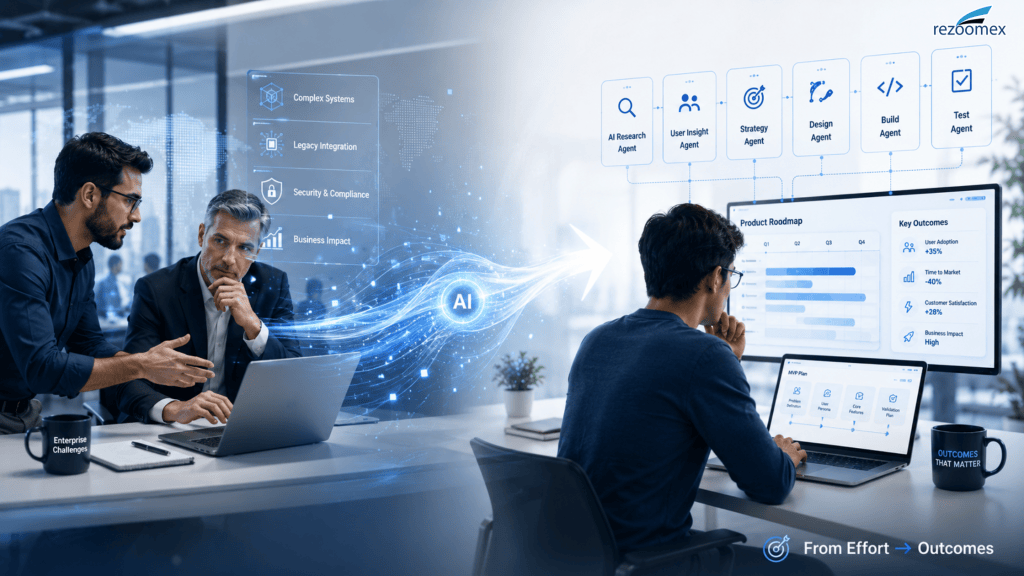
The Enterprise Playbook That Changed Software:
Imagine you’re the CTO of a Fortune 500 company.
You don’t need another CRM. You don’t need another dashboard.
You need technology that understands your business.
Your organization has:
- dozens of legacy systems
- thousands of employees
- strict compliance requirements
- unique workflows
- millions of customers
No off-the-shelf software is going to solve all of that.
This is exactly the problem Palantir set out to solve.
Instead of simply selling software licenses and leaving customers to figure things out, Palantir introduced a different approach—one that has become one of the defining characteristics of the company.
The Forward Deployed Engineer (FDE).
What Is a Forward Deployed Engineer?
A Forward Deployed Engineer is much more than a software engineer.
Think of them as a hybrid between:
- Software Engineer
- Product Manager
- Solutions Architect
- Customer Consultant
- Implementation Engineer
Rather than sitting inside headquarters building generic features, an FDE works directly with customers.
They spend time understanding:
- How the business operates
- Where inefficiencies exist
- Which systems need to integrate
- What the customer actually needs—not just what they requested
Then they build and customize solutions using Palantir’s platforms.
Unlike traditional consulting engagements where requirements pass through multiple departments, the FDE stays close to the customer throughout the journey.
They discover problems. They design solutions. They write production code. They deploy. They collect feedback. Then they improve the product again.
Why the FDE Model Works So Well
Traditional enterprise software often follows a predictable path.
Customer
↓
Sales Team
↓
Product Team
↓
Engineering
↓
Release
Every handoff introduces delays.
Requirements become diluted. Customer intent gets lost. Development slows down.
Palantir changed this.
Instead of several layers, the communication becomes much more direct.
Customer
↕
Forward Deployed Engineer
↕
Core Product Team
Now, the person solving the problem is also the person hearing the problem.
The feedback loop becomes dramatically shorter. The solution becomes significantly better.
Why Enterprises Love This Model
Large enterprises rarely have simple technology challenges.
A bank doesn’t just need software.
It needs software that works with:
- decades-old infrastructure
- strict financial regulations
- multiple departments
- thousands of daily transactions
- unique internal processes
The same is true for:
- governments
- healthcare providers
- defense organizations
- manufacturers
- global logistics companies
Every implementation is different.
That’s where an FDE creates enormous value.
But There Is One Important Reality
The FDE model is incredibly effective.
It is also incredibly expensive.
Every customer engagement often requires highly skilled engineers who combine deep technical expertise with business understanding and customer-facing skills.
These professionals spend weeks—or even months—working closely with a single customer.
That investment makes sense when the engagement itself is worth millions of dollars.
In practice, the model is best suited for large enterprise engagements, often involving seven-figure contracts, where the value created justifies embedding dedicated engineering talent.
For a Fortune 500 company making a multi-million-dollar technology investment, this approach can deliver exceptional returns.
For a startup building its first product? Not so much.
The Problem Smaller Companies Face
Now imagine a very different company.
A startup.
Twenty employees.
Limited budget.
Big ambition.
They also need help answering critical questions:
Who are our users?
What problem should we solve first?
Which features matter?
How do we validate the idea?
How should we design the product?
What should the MVP include?
How do we prioritize the roadmap?
These questions are just as important as they are for an enterprise.
But unlike a Fortune 500 company, the startup can’t afford to embed a highly specialized engineering team for months.
The economics simply don’t work.
Yet the need for product guidance is just as real.
Enter the AI Era
Artificial Intelligence is changing more than how we write code.
It’s changing the economics of product development itself.
Many tasks that once required significant manual effort can now be accelerated by AI:
- Research
- Market analysis
- User persona creation
- Requirements gathering
- User story generation
- Documentation
- Wireframing
- Test case creation
- Product planning
- Technical documentation
This doesn’t eliminate the need for human expertise.
It changes how that expertise is applied.
Introducing the AI Product Builder (AIPB)
If the Forward Deployed Engineer is a customer-embedded engineer…
The AI Product Builder is an AI-assisted product development framework.
Instead of assigning a dedicated engineering team to every customer, AI supports product teams across the entire lifecycle, helping them move faster while humans focus on judgment, creativity, and decision-making.
Rather than replacing engineers, it amplifies what they can accomplish.
Think of it as giving every product team access to capabilities that were once available only through large enterprise engagements.
The AI Product Builder Workflow
Instead of beginning with code…
It begins with understanding.
Idea
↓
Problem Discovery
↓
User Personas
↓
Jobs To Be Done
↓
Requirements
↓
Product Strategy
↓
User Stories
↓
Prototype
↓
Development
↓
Testing
↓
Iteration
AI accelerates every stage.
Humans guide every important decision.
The Key Difference
This is where many comparisons become misleading.
The AI Product Builder is not a cheaper Forward Deployed Engineer.
It solves a different problem.
The Forward Deployed Engineer model is optimized for implementing complex enterprise solutions in highly customized environments. FDE engagements are typically billable by the hour, with customers paying for dedicated engineering expertise embedded within their teams.
The AI Product Builder takes a fundamentally different approach. Rather than charging for time spent, AIPBs are paid based on outcomes. Whether it’s validating an idea, defining a product strategy, building an MVP, or delivering agreed milestones, success is measured by the value delivered—not by the number of hours worked.
The AI Product Builder is optimized for helping teams discover, design, validate, and build products more efficiently—especially when resources are limited.
One model measures engineering effort.
The other measures product outcomes.
Comparing the Two Models
| Forward Deployed Engineer | AI Product Builder |
| Human-centric approach | Human + AI collaboration |
| Embedded with individual enterprise customers | Supports teams through AI-assisted workflows |
| Billable by the hour | Paid based on outcomes |
| Best suited for large enterprise implementations | Suitable for startups, SMEs, and enterprises |
| Resource-intensive | Scales efficiently across multiple projects |
| Focused on customer implementation | Focused on end-to-end product development |
| Engineering effort is the primary engagement model | Business outcomes are the primary engagement model |
| Economics favor high-value enterprise engagements | Accessible at a much lower cost of entry |
Why AI Changes the Economics
Historically, scaling product expertise meant hiring more specialists.
More product managers.
More business analysts.
More UX researchers.
More architects.
More engineers.
AI changes that equation.
One experienced team equipped with AI can now perform many activities that previously required much larger teams or longer timelines.
The result isn’t just lower cost.
It’s greater accessibility.
Organizations that couldn’t justify enterprise-scale consulting can now adopt structured, AI-assisted product development practices.
A New Way of Thinking About Product Development
The real innovation isn’t AI writing code.
The real innovation is AI helping teams make better product decisions before code is ever written.
Because most product failures don’t happen due to poor programming.
They happen because teams build:
- the wrong feature
- for the wrong customer
- at the wrong time
An AI Product Builder aims to reduce those mistakes by improving discovery, validation, planning, and execution.
The Future Isn’t Human vs AI
The conversation often becomes polarized.
Will AI replace developers?
Will AI replace product managers?
Will AI replace consultants?
Perhaps that’s the wrong question.
The better question is:
How can AI help talented people deliver better outcomes?
That is where the greatest opportunity lies.
From Enterprise Privilege to Everyday Capability
The Forward Deployed Engineer demonstrated that embedding engineering close to customer problems creates better software.
The AI Product Builder extends that philosophy.
By combining structured product thinking with AI-assisted workflows, it makes many of those capabilities accessible to organizations that don’t have seven-figure budgets or dedicated enterprise engineering teams.
In other words, AI doesn’t diminish the value of the FDE model—it broadens access to its underlying principles.
Final Thoughts
Palantir’s Forward Deployed Engineer model reshaped how enterprise software could be delivered by bringing engineers closer to customer problems. It remains a powerful approach for organizations undertaking large, complex digital transformation initiatives.
The AI Product Builder represents a different evolution. It applies AI across the product lifecycle to help teams discover, validate, design, and build products more efficiently. While Forward Deployed Engineers are typically engaged on a time-based, billable-by-the-hour model, AI Product Builders are measured by the outcomes they deliver—helping organizations move from paying for effort to investing in measurable business results.
The future of software development isn’t about choosing between human expertise and artificial intelligence.
It’s about combining them to create products that solve real problems, adapt quickly, and deliver measurable outcomes.
In the years ahead, the organizations that succeed won’t simply build software faster—they’ll build the right products, measure success by outcomes, and use AI to turn ideas into impact.
That may prove to be the most important product playbook of all.
Akshay Moon is a digital marketing professional and technology writer at Rezoomex, where he explores the intersection of AI, blockchain, remote work, product development, and the evolving future of work. Through his writing, he shares insights on emerging technologies, global talent trends, outcome-driven work models, and how organizations can adapt to a rapidly changing digital economy.

