
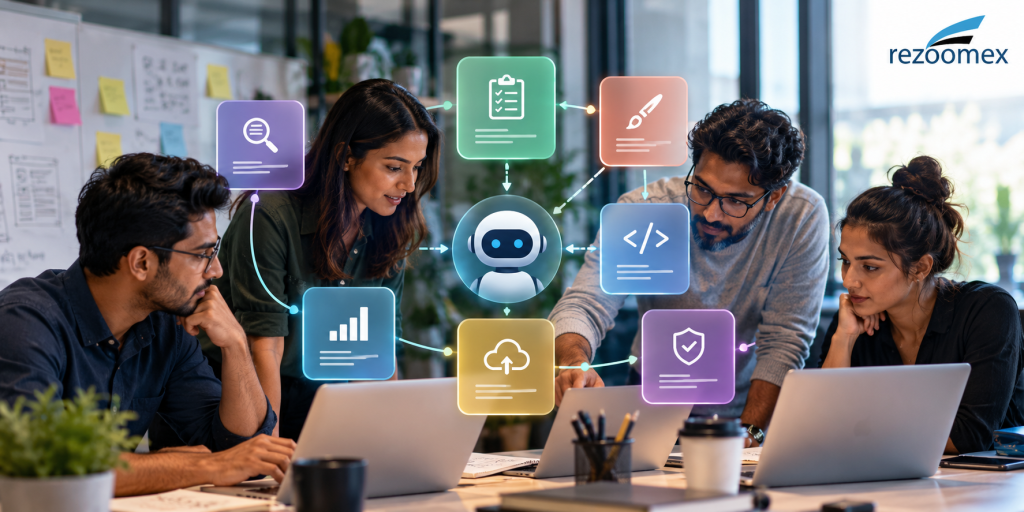
Can a team of specialized AI agents help turn an idea into a working product? And what still needs a human in charge?
Building a software product has traditionally required people with different skills: product managers to understand customer needs, designers to create user experiences, developers to write code, testers to find defects, and operations teams to manage deployment.
AI agents are beginning to change how these responsibilities are carried out.
Instead of using AI only to answer questions or generate code, product teams can now use specialized agents to research problems, propose solutions, develop features, test software, and monitor performance.
But there is an important distinction: building a product is not the same as solving a problem.
A successful product must address a genuine need, work reliably, and deliver measurable value. AI agents can accelerate many steps along that journey, but they still require direction, verification, and accountability.
What Exactly Is an AI Agent?
An AI agent is a software system that uses an AI model to pursue a defined goal, often by selecting actions, using tools, and working through multiple steps.
For example, a conventional AI assistant might explain how to fix a software bug. A coding agent with appropriate access could inspect the repository, identify the likely cause, propose a code change, and run relevant tests.
The difference lies in its ability to take actions within an authorized workflow, rather than simply provide an answer.
Not every AI tool is an autonomous agent. Some systems perform a single task, while others coordinate several actions and tools. The degree of autonomy varies considerably.
The AI Agents That Can Help Build a Product
Think of product development as a series of connected challenges. Different types of AI agents can contribute at different stages.
1. Research Agents: Understanding the Problem
Before developing a product, teams need to understand who experiences the problem, why it matters, and how people currently solve it.
Research agents can help by:
- Analyzing customer feedback, support tickets, and interview transcripts.
- Identifying recurring complaints and unmet needs.
- Comparing competing products and their features.
- Summarizing market research and emerging trends.
Example: A startup wants to build a scheduling tool for small clinics. A research agent analyzes anonymized feedback and discovers that missed appointments and complicated rescheduling are recurring frustrations.
That finding provides a starting hypothesis, not proof of demand. The team still needs to speak with users and validate the problem.
Human responsibility: Decide whether the problem is important enough to solve and whether the evidence is reliable.
2. Product Planning Agents: Turning Problems Into Requirements
Once a problem is understood, the next challenge is deciding what to build.
Product planning agents can help teams translate research into actionable product requirements.
They may assist with:
- Drafting product requirement documents.
- Writing user stories and acceptance criteria.
- Mapping user journeys.
- Comparing feature priorities.
- Identifying dependencies and potential risks.
Example: For the clinic scheduling tool, a planning agent proposes three initial capabilities: appointment booking, automated reminders, and simple rescheduling.
It also identifies possible requirements involving patient privacy, accessibility, and integration with existing clinic systems.
Human responsibility: Choose the product direction, establish priorities, and decide what belongs in the first release.
3. Design Agents: Exploring the User Experience
A product can be technically impressive and still be difficult to use.
Design-focused AI agents can help teams explore how users might interact with a solution.
They can support:
- Generating wireframes and interface concepts.
- Creating alternative user flows.
- Reviewing designs against accessibility guidelines.
- Drafting interface copy.
- Identifying potential usability inconsistencies.
Example: A design agent proposes a booking interface that allows clinic staff to reschedule an appointment in a few steps.
The team can compare several approaches before selecting one for user testing.
Human responsibility: Evaluate whether the design is understandable, accessible, and appropriate for the people using it.
4. Development Agents: Building the Product
This is one of the most visible applications of AI agents.
Development agents can work with code repositories, development tools, and test environments to help implement software features.
Depending on their capabilities and permissions, they can:
- Generate frontend and backend code.
- Create APIs and database queries.
- Explain unfamiliar codebases.
- Refactor existing components.
- Investigate bugs.
- Propose changes and run automated tests.
Example: A development agent implements an appointment reminder service based on approved requirements, creates tests, and prepares a code change for review.
Another agent might focus on the user interface while a separate agent works on the backend.
However, faster code generation does not automatically produce secure, maintainable software.
Human responsibility: Review architecture, code quality, security, integration, and technical trade-offs.
5. Testing and Quality Assurance Agents: Finding What Could Go Wrong
Software needs to work beyond ideal demonstration scenarios.
Testing agents can help teams identify defects and check whether a product behaves as expected.
Their responsibilities may include:
- Generating test cases from requirements.
- Running automated regression tests.
- Checking APIs and interface behavior.
- Investigating failed tests.
- Identifying potential edge cases.
- Supporting accessibility and security checks.
Example: A testing agent discovers that the clinic scheduling system allows two appointments to be booked for the same time slot under certain conditions.
The development team investigates the issue and fixes it before release.
AI-assisted testing can improve coverage, but it cannot guarantee that every defect or vulnerability has been found.
Human responsibility: Set quality standards, evaluate critical risks, and approve releases.
6. Deployment and Operations Agents: Keeping the Product Running
Launching a product is not the end of development.
Operations-focused agents can help teams manage the infrastructure and processes needed to keep software available and reliable.
They may assist with:
- Preparing deployment configurations.
- Monitoring application logs.
- Identifying unusual system behavior.
- Investigating performance problems.
- Summarizing incidents.
- Recommending infrastructure improvements.
Example: After the scheduling tool launches, an operations agent detects an increase in failed reminder deliveries and alerts the engineering team.
With carefully defined permissions, some agents can also perform limited corrective actions.
Human responsibility: Control production access, approve high-impact changes, and remain accountable for reliability and security.
7. Analytics and Feedback Agents: Measuring Whether the Product Works
This is where product development returns to its original purpose: solving a problem.
Analytics agents can help teams understand what happens after users begin interacting with the product.
They can:
- Analyze usage patterns.
- Track product performance indicators.
- Identify drop-off points in user journeys.
- Summarize customer feedback.
- Detect unexpected changes.
- Suggest experiments or improvements.
Example: The scheduling tool launches successfully, but an analytics agent finds that many clinic staff members abandon the rescheduling process halfway through.
Further investigation reveals that the interface requires too many steps.
The team simplifies the workflow and measures whether completion rates improve.
The important outcome is not that the scheduling feature was built. It is whether clinics can manage appointments more effectively.
Human responsibility: Interpret the evidence, distinguish correlation from causation, and decide what improvements are worth pursuing.
How These Agents Work Together
Imagine a small team developing a new software product.
Instead of asking one AI system to handle everything, the team organizes specialized agents around a shared goal.
The workflow might look like this:
Discover → Plan → Design → Build → Test → Launch → Measure → Improve
A research agent identifies potential user problems. A planning agent translates validated needs into requirements. Design and development agents create the initial solution. Testing agents evaluate its behavior. Operations agents support deployment, and analytics agents help the team understand the results.
An orchestration layer can coordinate tasks, pass approved information between agents, and track progress.
However, these handoffs need clear boundaries.
A research agent’s findings should not automatically become product requirements. Generated code should not automatically enter production. And an analytics agent’s recommendations should not automatically change the product.
Each stage needs appropriate checks, especially when decisions affect customers, security, finances, or sensitive information.
Where Does the AI Product Builder Fit In?
As specialized AI agents take on more execution tasks, an important question emerges:
Who connects all these activities to the original business problem?
This is where the concept of an AI Product Builder (AIPB) becomes relevant.
An AI Product Builder is a product-focused professional who combines technical understanding, product judgment, and AI capabilities to move a solution from problem discovery to measurable outcomes.
Rather than performing every task manually, an AIPB can coordinate people, tools, and specialized AI agents.
Their responsibilities may include:
- Defining the problem and desired outcome.
- Selecting suitable AI tools and agents.
- Providing context, constraints, and success criteria.
- Reviewing outputs and managing risks.
- Coordinating implementation and feedback.
- Measuring whether the solution delivers value.
The AIPB is not necessarily a replacement for a product manager, designer, or software engineer. It is an emerging way of organizing product ownership and execution around AI-assisted workflows.
The role becomes especially interesting for small teams that need to work across multiple disciplines without losing focus on the customer.
What AI Agents Still Cannot Replace
AI agents can accelerate work, but they have limitations.
They can misunderstand requirements, generate incorrect information, introduce defects, and optimize for the wrong objective.
They may also lack the organizational context, customer empathy, and practical judgment needed to make difficult product decisions.
Consider a product that is delivered on schedule, passes automated tests, and performs exactly as specified.
What if customers still don’t use it?
From an engineering perspective, the project may look complete. From a product perspective, the original problem remains unsolved.
That distinction is why human oversight matters.
AI agents can help execute the work. People must remain accountable for choosing the right work and evaluating its impact.
The Real Opportunity: Smaller Teams, Broader Capabilities
The promise of AI agents is not simply that fewer people can produce more code.
It is that teams may be able to explore ideas faster, test assumptions earlier, reduce repetitive work, and spend more time understanding customer needs.
A small product team could potentially coordinate several specialized agents while concentrating its own effort on strategy, architecture, customer relationships, and critical decisions.
But this advantage depends on how effectively the team manages complexity.
Poorly coordinated agents can create more code, more documentation, and more work to review without improving the product.
The goal should not be maximum automation.
It should be better outcomes with the right balance of automation and human judgment.
Final Thoughts: From Building Faster to Solving Better
AI agents are expanding what product teams can accomplish.
Research agents help explore problems. Planning agents organize requirements. Design and development agents accelerate implementation. Testing and operations agents support reliability. Analytics agents help teams learn from real-world usage.
Together, these capabilities can make product development more iterative and accessible.
But the most important question remains unchanged:
Did we solve the problem we set out to solve?
That is the principle behind the AI Product Builder approach.
The future of product development may involve many specialized AI agents, but successful products will still depend on clear goals, informed decisions, and responsibility for results.
Build what matters. | Rezoomex
Akshay Moon is a digital marketing professional and technology writer at Rezoomex, where he explores the intersection of AI, blockchain, remote work, product development, and the evolving future of work. Through his writing, he shares insights on emerging technologies, global talent trends, outcome-driven work models, and how organizations can adapt to a rapidly changing digital economy.

